Showing posts sorted by relevance for query wells history. Sort by date Show all posts

Tuesday, April 14, 2015

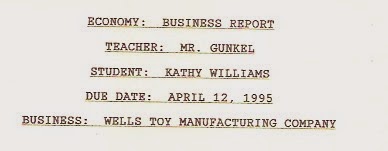
1995 Wells Mfg. Business Report

Wells Mfg. was the subject of an Government/Economic Class Business Report, written by Kathy Williams, a student in the spring of 1995.  The report and a follow-up letter is scanned and transcribed below.

Her perspective on New Vienna and Wells are interesting.  As a reminder, Wells Mfg., the company and property in New Vienna, was sold in 1999 and is no longer owned by the Uible family.  [My comments included in bracketed italics.]

Other articles about Wells include:


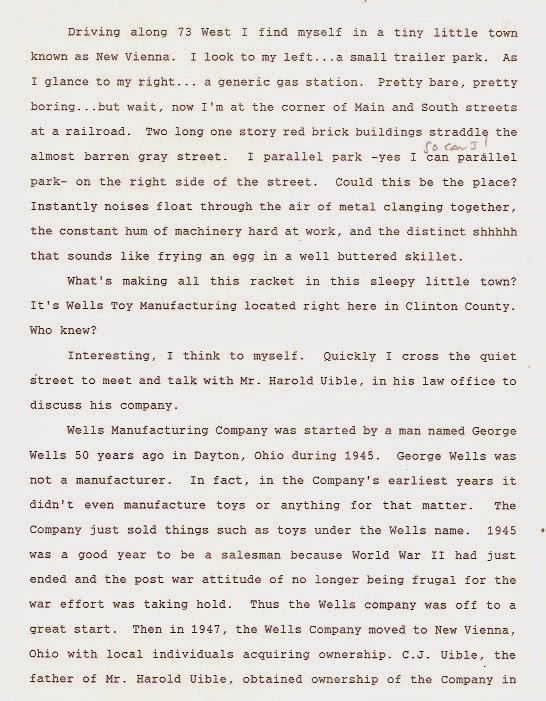
Driving along 73 West I find myself in a tiny little town known as New Vienna.  I look to my left . . . .a small trailer park.  As I glance to my right . . . a generic gas station.  Pretty bare, pretty boring . . . but wait, now I'm at the corner of Main and South streets at a railroad.  Two long one story red brick buildings [the upper floor of the old hotel part of the main building must have gone unnoticed] straddle the almost barren gray street.  I parallel park –yes I can parallel park– on the right side of the street.  Could this be the place?  Instantly noises float through the air of metal clanging together, the constant hum of machinery hard at work, and the distinct shhhhh that sounds like frying an egg in a well buttered skillet.

What's making all this racket in this sleepy little town?  It's Wells Toy Manufacturing located right here in Clinton County.  Who knew? 

Interesting, I think to myself.  Quickly I cross the quiet street to meet and talk with Mr. Harold Uible, in his law office to discuss his company.

Wells Manufacturing Company was started by a man named George Wells 50 years ago in Dayton, Ohio during 1945.  George Wells was not a manufacturer.  In fact, in the Company's earliest years it didn't even manufacture toys or anything else for that matter.  The Company just sold things such as toys under the Wells name.  1945 was a good year to be a salesman because World War II had just ended and the post war attitude of no longer being frugal for the war effort was taking hold.  Thus the Wells company was off to a great start.  Then in 1947, the Wells Company moved to New Vienna, Ohio with local individuals acquiring ownership.  C.J. Uible, the father of Mr. Harold Uible, obtained ownership of the Company in 1949.

Early products manufactured by Wells were plastic novelties like sponge balls and then later jacks and corn holders.  Workers were paid only $0.55 an hour which was very good pay back in the mid to late 1940's.  Today while browsing through Walmart, K-mart, a supermarket or of course a toy store it's highly probably [sic] to come upon a product manufactured by Wells.  Such products include Bubbly Joy, sponge balls, gloss balls, paddle balls, "pinkie" balls, soft baseballs, plastic bats and balls, paddle balls [duplicated], jacks, jump ropes, pinwheels, chalkboards, marbles, yo-yos, and "fun combinations" which may entail any number or variety of the above named products.  Although the Buckeye State is the Company's biggest buyer, Ohio isn't the only place where one would find a product manufactured by Wells because Wells distributes their products in all 50 states and even does some business in Canada and Mexico.

Pretty amazing considering Wells only location is in New Vienna, employing just 40 people and occupying only 100,000 sq. ft. of land.  But the small size of Wells hasn't affected the demands for the company's products.  Wells #1 selling item is the soap bubble bottles withe the "magic" bubble wand inside selling 3 million a week.  The second biggest seller for Wells is the rubber sponge ball which number 100,000 balls per week.  On the other hand, jump ropes are low on invoice orders.  For example for every 200 cases of bubble joy sold, only 4 [cases?]  jump ropes are sold.  Mr. Uible says his bubble joy sells so much more because once it's used up it's gone forever as opposed to a jump rope which can last a lifetime.

Mr. Harold Uible is president and sales director of Wells Manufacturing.  Business associates include: vice president Gene Williams, secretary and personnel director Carolyn Rhonemus, treasurer and head of finance GiGi [GG] Walker, purchasing Ted Walm.

In dollar figures, Wells pulls in $2 million in annual sales; payroll expenses are $10,000 a month. Liability insurance is around $35,000 a year, and utilities are about $4,500 a month.  

Wells main competition comes from China and Mexico where labor is cheaper than here in the U.S.  Although competition really comes from all kinds of other "impulse buy" products one sees at the end of checkout lines in grocery, discount and drug stores.

Ohio is the state that buys the most from Wells, and Mr. Uible says Wells is in Ohio to stay.  When I asked Mr. Uible about the future of Wells, he stated cheerfully, "optimistic, you gotta be."

Buying new manufacturing equipment and keeping up the pace with the electronic age are definitely in the plans ahead for the Company.  Mr. Uible's philosophy on business is simple and has obviously proved successful, "Make a good product and people will buy it!"

O.K. so wells is not the typical corporate giant, in fact the stock is even kept in the family.  But then again being small is what makes Well's [sic] in the sleepy little town of New Vienna Wells Manufacturing Company has quietly been producing toys for children all over the United States to play with and enjoy.  Wells has also weathered the harsh business world for 50 years with an optimistic outlook for the future.  A large accomplishment indeed!

* * * * *
[note from teacher, Mr. Gunkel] This is an excellent report!  I do question your monthly payroll with 40 employees.  

[grade =] 99

* * * * *
[Follow up letter from Kathy Williams]

4-19-95
Mr. Uible,

Greetings! 

Thank you so much for the interview for my government/economics project.  I really appreciate the time you took to help me and helping me learn about stocks.  I recieved [sic] the 2nd highest grade out of the entire senior class . . . a 99.  I'm sending you a copy of my report.  You're welcome to keep it if you like because I have the report saved on my computer.  (I think I might have a strange figure down for the monthly payroll ~~?) . . . Anyway – Thanks again for helping me create a successful paper!

Sincerely,
                           Kathy Williams

P.S. – Best of Luck for continued success in Wells' Future!

Sunday, May 15, 2011

New Vienna Firm [Wells] is Moving to New Building (1 of 2) - May 15, 1952

The Leesburg Citizen, run by locally famous Mack Sauer [note the ad for "Breakfast at Sauer's" on WPFB in top left corner of front page of newspaper], ran a 4-page special edition on Thursday, May 15, 1952 in honor of Wells Mfg., moving to their new building on West Main Street, New Vienna. Besides talking about the company, the open house and the $40,000 remodeling job, there is also a section on the history of the building (below the fold).  See below for transcription of history.  
Part 2 will feature pictures of products and office employees. 
New Vienna [Ohio] Firm [Wells Mfg.]is Moving - Leesburg Citizen, May 15, 1952


New Vienna Plant to Hold Open House Friday


The Wells Mfg. Company, New Vienna, will hold open house in their new $40,000 plant Friday, May 16 from 1 to 5 and 7 to – P.M.

The new headquarters contain 10 rooms, including 3 offices, assembly rooms, storage rooms, etc.  It is modern to the minute.
The Buckeye Ramblers, Wilmington, will play for round and square dancing in the assembly room Friday evening. Dancing will be free to everyone.  There will be roses for the ladies and toys for the children.
Mr. C. J. Uible, president, extends a cordial invitation to everyone to attend the open house.
Hotel Fealy, New Vienna Ohio [later Wells Mfg.] Corner of Main & South St., Built in 1878, across from Train Depot
Leesburg Citizen clipping from May 15, 1952 about Wells Mfg.

Building History
The company purchased the old Fox building at the railroad crossing in New Vienna at public auction in Sept. 1950.  The building had gone through a disastrous fire and had to be almost entirely rebuilt.  This was done with Vaughn Huffman as contractor and Mr. Uible as supervisor.  Fifty-two thousand face brick were used in reconstructing the walls.

The original building was was erected in 1878 [Another source says 1883] by Truman Peale, who operated a general store in the downstairs rooms.  The upstairs was used as a city hall and for roadshows, dancing, etc.

It was later remodeled and was known as the Phaley [Picture above clearly shows Fealy] House and later the Elton Hotel.  In recent years the Fox Restaurant was located there and Leo Dodds had apartments upstairs.  It was hit by fire in March, 1950, and Mr. Dodds' widow sold the building at public auction to Mr. Uible.

Mr. Uible spared no expense in rebuilding.  Offices have hardwood floors, sound proof ceilings, venetian blinds, and are modern to the minute.  The rest rooms have tile walls and are equipped with showers for the employees.

An elevator shaft has been installed and later an elevator will be installed between the first and second floors.  [This never happened, I think for structural reasons.] The first floor has 10 rooms, including 3 offices, assembly room, storage rooms, stock room, etc.  The upstairs is not yet completed, but assembly rooms will be finished there at a later date.

The building is 170 by 44 feet.  The new addition at the rear is 78 feet by 44 feet.

Mr. Uible, retired contractor, is one of New Vienna's most prominent businessmen.  He has served on the village council for many years and has always been one of the town's most loyal boosters for every improvement.

He is warmly congratulated by the citizens of New Vienna on the fine, modern home he has constructed for the company he heads.


******
See Part Two of the Leesburg Citizen May 15, 1952 article on Wells Mfg. moving into their new building at this link.


1 comment:

  1. John Levo adds: I barely remember my parents going to the grand opening of the new building. I think I was given a green yo-yo.
    The article makes mention of the Fox Restaurant. It was run by Georgia Fox and her mother. When they relocated, they went to the building next to the village park. Georgia had her restaurant and her brother lived upstairs and ran a card game in the front room. I think he also did some work for the township or village. I never heard him called anything but Bullger. My parents bought the building in 1965 from Georgia and moved the trophy business from our den at home to the building. In addition to the trophies, he and Doc South sold a line of pet and animal health supplies. Hard to believe that it has been 50 years since Red Dot was established.

Wednesday, November 17, 2021

1961 HH's Letter to Catherine -Nov.30


[A copy of the backside of the letter is included since it is a flashback to the early days of Wells Mfg.  For more details about the history of Wells, see the blogposts at this link:  Wells History]

Thursday night, November 30, 1961

Miss Catherine Uible
1025 North B Street
Lake Worth, Florida

Dear Miss Uible:

Catherine, that is the way an important letter would start.  Since what I have to say or rather write is not too important I would at least give you the "important start".

As the News-Journal would read, John had a luncheon guest yesterday, Tommy Kuntzman, who spent part of the afternoon visiting with his host.

Serena is reading all the letters in sight on the table -- such as "corn", "flakes", "rice" and everything else in like vein.

Roberta is going strong on the music practice, especially at clean up time after mals.  She and Serena are both looking (?) forward to their report cards tomorrow.  Serena wants to get "S" and not "U" marks for her name.

Sounds like the Hortons are really taking care of our 7th grader.  Wonder what our excuse was in not getting you a pocket dictionary like Marianne wrote you?

How does school seem in LW?  How about the meals at school?  Think that Nancy Henderson called last night (she didn't identify herself to me) and wanted to know your address, gave her the B Street address.  Then she wanted to know if the K Street address was still OK.

Do you still get up early in the morning and how is the funny page in the Florida papers?  Don't forget to send us the diagram on the Knoxville "shortcut" for three weeks from today we will be down that way.

Am mailing to you an important letter -- you might endorse it to Uncle Bill on your bike rental charge.  Do the Hortons need any jacks or ropes?

Happy December,
Daddy

Sunday, July 14, 2013

Wells Mfg. in Dayton

For more information about the history of Wells Mfg. after they moved to New Vienna, see Wells Mfg. History.

1945 Wells Mfg. original location, 3196 Delphos Ave., Dayton, Ohio.  
The company moved to New Vienna in 1947 or 1948.

1947 Wells Mfg. (Dayton, Ohio) Purchase Order

This particular purchase order was not used as originally intended, but the reverse served as a copy of a letter to a NYC hotel for reservations in July 1963.

Wednesday, June 01, 2011

Wells Mfg. History

The following was written in early 2000 by HH Uible and was originally transcribed by Serena.  

Since 1947 Dad [CJ Uible] had become involved in a Wells Mfg. (started by George Wells in Dayton in 1945) and in which I was also active.  The first location in New Vienna is the present Senior Citizens building where the rent was $100 a month.

The original owners had several fast talkers in the organization who were paid a commission of sales and soon the company was broke.  They moved to Milwaukee and started a company called Jak Pak.

In 1949 Wells bought the old hotel at the corner of SR-73 and Main Street for $900 as there had been a fire in the building and it needed help.  The going wage rate then was 55 cents an hour and I was lucky enough to get on the payroll at $35 a week.

In 1950 Bill Horton [CJ's son-in-law] and family moved to Florida and I became more active in sales work.  At that time Wells did not make anything, they bought the jackstones, the balls and put the items together.  Then a small set retailed for 5¢.  The only sales organization was a rep from Barr Rubber in Sandusky from whom we bought the balls.  He carried the Wells line and through contacts eventually had reps in most of the areas.

Every year we would got to the Toy Show in New York City which then ran for ten days and is now (in 2000] down to three days.  In the early 1950s hotels in NYC were $4/night and we would eat hot dogs from street vendors.  Every year we would make the rounds of the major chains in New York and then swing out through Kansas, Oklahoma City, Dallas and back through Nashville to home, a two week trip.  As we all know the little guys have gone out of business and the big guys are so powerful they tell you what they will pay, so was quite happy to sell the business in 1999.

In those days we had to punch the holes out of the jack cards where the balls went.  The only material handling equipment was a two wheel truck, so when a 40,000 pound load of zinc came in, that had to be unloaded one bar at a time.  (Each bar was 20 pounds.  We bought the zinc from a firm in Chicago that had apartments in the John Hancock Tower and we all enjoyed a number of visits there.  Catherine had an intern job at Marshall Fields while in college.)

Some of the earlier Wells products included lawn sprinklers -- they were too good as they never wore out; key chains and coin holders (with the advent of parking meters); bond boxes where one kept valuable papers (really no more than a metal box about the size of a small safety deposit box); yo-yos, flying saucers where there were two balls on the end of a rubber string and when in motion the balls would go in opposite directions; cyclone spinners -- a plastic disc that had holes and when pulled by the two strings would make a noise.  Later on we made plastic bats and balls.

About 1960 we got into the bubble business and eventually had a complete packaging line consisting of a bottle unscrambler (which put the correct end of the bottle up), a filler, capper, labeler, etc.  The 8 oz. was the most popular seller and it would sell by the truckload.  Also had a 4, 16, 24, 32 and 64 oz. bottle size, all of which we made on the four blow molding machines.

Our biggest step was to start making rubber balls, and as Goodyear said it was a challenge, which we never fully mastered 100%.  Besides the rubber mill, there was an extruder to get the rubber into rope like shape and then a cutter for the slugs and finally the 21 presses where the actual balls of different sizes were made.

Over the years we had employment as high as 70 people and a lot of very loyal people, like Phyllis J. Tilton White who was there for 35 years, Donna Brown for 33 years, Esther Salisbury for 20+, Mildred Storer, Gene Williams and Fred Hughes who came for a couple of weeks and stayed for over 20 years.  Elvis Wiget who started at $2/hour and went up.  In 1999 the basic wage rate was $6.50/hour.  Not much but too much to make a profit at the selling price that competition required.

In selling jacks one of the customers suggested that we put information about obtaining the rules on the back of the card, which we did.  At the peak of business we would receive around 50 letters a day requesting the rules.  Mother [Gladys Hiestand Uible] seemed to enjoy answering these jack letters, especially after CJ's death [1969] and would mark in the atlas book where the requests came from.  Children were requested to send a dime to cover the cost which was adequate in the early days when postage was two cents.  Sometimes children would send 10 pennies which resulted in postage being due.

As it became increasingly hard to make a profit, even though I drew no salary, I announced in the spring of 1999 that we would close.  Easier said than done for I really didn't want to have an auction.  Thanks to John and his connections the business and property was sold to Grant and Glenn Douglas of Columbus who formally bought Wells in November of 1999.  Hopefully they will make a success of it.

Tuesday, November 27, 2018

1988 Wells Fun Factory Clipping -Nov.12

The following clipping is from the Dayton Daily News, Saturday, Nov. 12, 1988.  Stories by Bob Batz, Photos by James Rutledge.

Note: Wells Mfg., the company and property in New Vienna, Ohio, was sold in 1999, and is no longer owned by the Uible family.  For more information see 1995 Wells Mfg. Business Report.
Above: Virginia Perkins monitors the dipping of new rubber balls into various bright colors of paint.  On right: New jump ropes turned out at the Wells plant.
Above, Mildred Brooks, a 25-year employee of Wells Manufacturing, watches a machine combine strands of colorful thread into jump ropes.  At right Robert Mongold (name is misspelled in caption) inspects a gate of new jacks, fresh from the molding machine.
Wells Manufacturing owner Harold Uible

NEW VIENNA –– Sometimes when Mildred Brooks is working at her braiding machine at Wells Manufacturing Co., she catches herself remembering another time, a time when she got together with other girls on the sun-splashed playground at a little elementary school near Vanceburg, Ky., to do swishes and sweep-the-floors while singing, Out goes the doctor, out goes the nurse / out goes the lady with the alligator purse.

Isn't it nice to know that in this age of high-tech toys, somebody's still producing playthings from the past?

In Southwest Ohio that somebody is Wells, one of the last companies in America manufacturing jump ropes and jacks.  In 1987, Wells' 50 employees cranked out five million jump ropes and more than a million sets of jacks.

They also made balls, yo-yos, plastic baseball bats, pinwheels, paddle ball sets and bubble blowing kits.

The bossman at the factory which sprawls over three city blocks in this Clinton County farming community of a a few thousand is soft-spoken, white-haired Harold H. Uible, who has spent 39 of his 63 years in the toy business.

Wells Manufacturing, according to Uible, got its start in Dayton in the early 1940s when a fellow by the name of George Wells started making and selling metal boxes, key holders and ballpoint pens out of a spare room in his house on Delphos Avenue.

"Wells was quite a guy, and he had a couple of crackerjack salesmen who could sell refrigerators to Eskimos," Uible recalls.

The manufacturing operation was moved to New Vienna in 1947.

"Even though a lot of folks don't realize it, we ship our toys all over the world.  I've had Ohioans tell me they were really surprised when they picked up a jump rope in a store in some town like Boondock, Idaho, only to discover it was made right here in New Vienna, Ohio," Uible explains.  

After offering a tour of his factory, Uible heads for the jump rope room.

Each of the many rooms at the factory is devoted to a different operation.

The jump rope room, which has more than a dozen braiding and winding machines, is one of the noisiest.

It all starts with spools of bright-colored yarn that is wound into braids on one machine, then fed into another machine that transforms the braids into jump rope.

After the rope is cut and a plastic handle is attached to each end, the jump ropes are packaged for shipping.

Mildred Brooks, 62, has been making jump ropes at the factory for 25 years.

"Oh, yes, I jumped rope when I was a little girl.  Why, if I remember correctly, I was the fastest jumper at my little rural school near Vanceburg, Ky.," she says, her words wrapped in a soft Kentucky twang.

She picks up a piece of jump rope.

"We didn't have rope like this, though.  The rope we used was old stuff that most likely came out of somebody's barn," she says.

Sylvia Smith, 49, who works with Brooks in the jump rope room, also remembers when she jumped rope as a child.

"My favorite jump rope game was called High Water and I could jump higher than my own head," she recalls with a smile.

Some people don't believe Smith when she tells them what she does for a living.

"Most of 'em just look at me and say, 'Oh, go on, you don't either make jump rope,'" she says.

While the jump rope room is noisy, the room where they make the jacks is noisy, and hot.

That's because the jacks are made by the metal die cast process using 20-pound metal ingots.

First the ingots are melted at 800 degrees in a cauldron-like machine.  Then the molten metal is fed into the die cast machine, which every 30 seconds stamps a "gate" of 144 jacks.

After the jacks have cooled, they are cut apart.  Some are painted; others are left plain.

As those machines churn out jacks, Linda Thomas is busy making balls in the next room.

The company, according to Thomas, makes millions of balls each year; big balls, small balls, paddle balls, jack balls and footballs.

The high-ceilinged room is filled with machines, including some capable of turning out more than 800 balls at a time.

Thomas says she used to work at a nursing home.

"But this job's a lot more fun," she says, using an air hose to blow another batch of paddle balls out of a machine and into a storage container.

No tour of this toy factory is complete without a visit to the paint room and a chat with Virginia Perkins, who calls the factory her second home.

"I love two things in life.  One's my husband.  The other's my job," Perkins says as she drizzles blue, yellow and red paint into a water trough.

As she waits patiently for another rack of balls to swish through her paint swirls, thousands of balls in every color move along the ceiling on a conveyor.

"Ain't they pretty, though?" Perkins proclaims.

Then she smiles and adds, "I love this room.  It's Christmas and the Fourth of July all rolled into one."

The toy business is a $20 billion a year industry in the U.S., according to Uible.

"Trouble is, many of the toys that are sold in this country these days are imported.  Remember, we have workers who earn more in an hour than some foreign workers make in a whole day," he says.

Uible believes jump ropes, jack sets ad pin-wheels will be around long after most of today's you-gotta-have-a-gimmick toys are gone.

"These toys are a lot like dolls.  There will always be a demand for them," he says.

Here's a skip through history of jacks and jump ropes

Once and not too long ago, either, jumping rope and playing jacks were as much a part of growing up in America as washing your hands before dinner and wearing your leggings in the wintertime.

The two games reached the peak of their popularity in the late 1940s and early 1950s.

Rope-jumping (or skipping, as some call it) was actually invented by ancient Egyptians who made rope out of strands of hemp.

To get to the hemp, the rope-makers had to jump over the ropes they had already made.  Before long, their children – who were playing nearby – began imitating them.  Later, when the kids were given ropes to play with, they began inventing jump rope games.

Dutch immigrants brought jump ropes to America in the 1600s, and in the 1700s most of the rope jumping was being done by boys.

By 1945, however, rope-skipping had become a for-girl's-only pastime, and today, even though it isn't all that popular with youngsters any more, it is considered an excellent form of exercise.

The object of the game is to jump the rope the prescribed number of times without missing.

A miss quickly turns a "jumper" into an "ender" – one who holds the rope for other jumpers.

"Ender" is just one bit of jump rope jargon.  Other terms include black sheep, a novice jumper, salt, a slow-turning rope, and duck skipping, jumping the rope while in a crouched position.

Popular jump rope games from the past include Winding the Clock, Baking Bread, Chasing the Fox, Skimming Milk, Grinding Coffee, Climbing the Stairs and Running Through the Moon.

Jacks, also a game enjoyed mostly by girls, probably was derived from "jack stones," an old Bolivian game that was played with five pebbles and a marble.

The basic jacks set sold in the U.S. today consist of six jacks and a small rubber ball.

After two players, who sit facing each other, decide who will start play, that player scatters all six jacks on the floor.  Then she tosses the ball into the air, picks up a jack in her right hand, then catches the ball with the same hand after it bounces once.  Southpaws are allowed to toss and catch with their left hands.

If the player misses the ball or drops a jack or allows the ball to bounce more than once, play passes to the second player.

The tossing and catching continues until all the jacks are picked up.

After both players successfully retrieve all six jacks one at a time (the game is known as onesies), they start over picking up two jacks at a time (twosies) and so on.

Other jacks games include Eggs in the Basket, Pigs in the Pen, Crack the Eggs, Slugsnail, Over anad Back, Scatters, Sweeps and Scrubs.

Thursday, February 17, 2011

Your Town: New Vienna Ohio: Wells Mfg. (Part 4 of 5)

New Vienna, Once Buzzard's Glory Prospers Anew in Clinton County
A full page spread in the Cincinnati Times-Star, February 26, 1957 (p.16)  by Mayo Mohs [Part 4 of 5]

Ancient Game of Jacks is Town's Young Industry:

For children all over the world, the game of jacks, in one form or another has been a favorite since civilization began.  

In the streets of early Egypt, they played jacks with animal bones; in other places they played the game with pebbles, thus the name "jackstones."

Now, of course, almost everybody uses the familiar six-pointed metal jacks, and it is these that provide New Vienna with an industry.

The Wells Manufacturing Co., a New Vienna landmark since 1945, today sends jacks to all parts of the country and the globe.  Because of such a tremendous international use, and understandably for economy, the jacks are mass-produced like most other products of the modern world.  

Hot from the casting machine, the zinc alloy jacks come in waffle-like sheets, at the rate of several hundred a minute, are trimmed, weighed and sometimes colored in ensuing processes.
Picture captioned: City Solicitor for New Vienna, Harold Uible doubles as vice president of the Wells Manufacturing Co.  Here he checks over a pile of jacks before they are packaged.  Mrs. Ernest [Ocie] Wilson, New Vienna, left and Mrs. Mason Parr, in rear, keep busy at their packing jobs.  The company employs some 12 persons.  President of the concern is C.J. Uible, father of Harold.
-----
This is the fourth of five posts from New Vienna, Once Buzzard's Glory Prospers Anew in Clinton County. Other posts can be found at these links:
Part 1 History
Part 2 New Vienna in 1957
Part 3 Southern Ohio Tool & Die
Part 4 Wells Mfg.
Part 5 Aerial Photo


Friday, February 18, 2011

Your Town: New Vienna Ohio (Part 5) Aerial Photo

New Vienna, Once Buzzard's Glory Prospers Anew in Clinton County
A full page spread in the Cincinnati Times-Star, February 26, 1957  by Mayo Mohs* [Part 5 of 5]

Aerial view of New Vienna Ohio 1957 looking south


1) NV Grade and High School, 2)Methodist Church, 3) St. Michael's Roman Catholic Mission, 4) Randall Co., 5) Carter Tool & Die, 6) Post Office & Municipal Building, 7) NV National Bank, 8) Masonic Hall, 9) Odd Fellows Hall, 10) Mongold Oil Co. 11) NV Grain Co., 12) Church of Christ, 13) Nasa Tool Co., 14) Depot, 15) Southern Ohio Tool & Die Co., 16) Farm Bureau Co-op.
Not marked is the water tower, situated right next to 5) Carter Co. [Also not marked is Wells Mfg., to the left of 14) Depot. 15 and 16 are on the far right of the map, not showing here.]

Note what looks like a Railroad Spur track from the left of #11 (Grain Co.), crossing Main St. and curving toward West St.  Wonder if there was a business in that area at the turn of the century or earlier?

*Mayo Mohs, under whose byline the Your Town feature on New Vienna was written, was born in 1934 and became an international figure in the world of journalism, working for Times Magazine as well as the Cincinnati Post Times-Star.  The Xavier graduate of 1955 became interested in journalism while attending Xavier where he earned degrees in history and political science.  He died in a car accident near his retirement home in Santa Monica, California in 1996 at the age of 62.

This is the concluding post from New Vienna, Once Buzzard's Glory Prospers Anew in Clinton County.  Previous Posts can be found at these links:

Part 1 History
Part 2 New Vienna in 1957
Part 3 Southern Ohio Tool & Die
Part 4 Wells Mfg.
Part 5 Aerial Photo

Friday, April 20, 2012

Fealy: Hotel and GHU Neighbor

Hotel Fealy, New Vienna Ohio [later Wells Mfg.] Corner of Main & South St., Built in 1883, diagonally across from Train Depot.  c1910
Harold Hiestand Uible (~9) and Katherine McCabe Fealy (~69, born 1865) at back of her house which was next door to CJ Uible house on Main St., New Vienna, Ohio c1934

Katherine (1865-?) and her husband, William Fealy (1864-?) were both born in Ohio, though their parents were all from Ireland.  In 1900 they lived in a rental house in New Vienna along with Katherine's widowed father, James McCabe (1830-?).  Their neighbors included Ray Gilliland, Dudley & Cora Borden, Mary Leverton, Roy Brown, Pleasant & Pearl Wright, William Ruble and the Chaney family which included Harry, Clarence, and Benton.  William is listed without a occupation in the 1900 census.

William Fealy's parents, William Sr. (1829-1914) and Ellen (1833-?) and two of their ten children, Ellen (1862-?) and Mary (1874-?) are also shown as living in Green Township.  William's occupation is listed as Hotel Keeper, though he is shown as living in a rental house.  Four boarders are also shown as living in that residence, a landlord - Thomas Rodgers (1824-?); Machinist - George Sharp (1873-?); Typesetter - Thomas Ludlen (1871-? from Ireland) and Druggist Proprietor - John Bettatas (1844-?).  The William & Lydia Fox family lived next door.  William Fox was a saloon-keeper, probably at the hotel.  A Fox family was later associated with the hotel and saloon.

In 1910 Katherine is listed as living with her 12-year-old niece, Agnes McCabe.  In 1920 Katherine is living alone on Main St. in New Vienna.  Her neighbors include: Charles & Sarah Williams, the Merrill family, Jane & Jennie Woodmansee, Ellen Honline, Isaac & Hallie Pendall, and Edward and Olive Brown.  (Olive 1862-?) is an author of an early version of New Vienna history.

2 comments:

  1. Catherine Uible Morgan Tue Apr 24, 11:35:00 AM 2012
    From HH: That hotel had one bathroom upstairs, it was in the farthest room from the RR station . The two front rooms of the Hotel were double rooms. As I recall CJU bought the building for $900.00 in 194?.
    From Catherine: Here's the link to the article with more history of the building: http://uible.blogspot.com/2011/05/new-vienna-firm-wells-is-moving-to-new.html. And a quote from that 1952 article:  "The company purchased the old Fox building at the railroad crossing in New Vienna at public auction in Sept. 1950. The building had gone through a disastrous fire and had to be almost entirely rebuilt. This was done with Vaughn Huffman as contractor and Mr. Uible as supervisor. Fifty-two thousand face brick were used in reconstructing the walls.  The original building was was erected in 1878 [Another source says 1883] by Truman Peale, who operated a general store in the downstairs rooms. The upstairs was used as a city hall and for roadshows, dancing, etc.  It was later remodeled and was known as the Phaley [Picture above clearly shows Fealy] House and later the Elton Hotel. In recent years the Fox Restaurant was located there and Leo Dodds had apartments upstairs. It was hit by fire in March, 1950, and Mr. Dodds' widow sold the building at public auction to Mr. Uible."

Wednesday, April 13, 2011

Snow Hill Pictures and Future Posts

Snow Hill Country Club, Wilmington Ohio [New Vienna] Aerial view 1924 - Image Courtesy of Mike Whited
Sunday, November 9, 1924 – Snow Hill Country Club, Wilmington, Ohio.  This picture was taken during the opening exercises, attended by 1,500 residents of Wilmington and vicinity.  Snow Hill, the early home of Mrs. George Dent Crabbs, Cincinnati, was built by her great-grandfather in 1820.  She had the homestead restored and gave it to the club.  Captain John W. Pattison* and Lieutenant Wright Vermilya*. 

In the interest of sharing more pictures sooner (and getting ahead of my self-appointed deadlines), I'm sharing pictures without much historical research to go with them.  I love the research part (or I wouldn't be doing it) but it can be a big drain of time; fascinating, but time consuming.
Snow HIll Country Club, October 13, 1924, New Vienna Ohio - Image Courtesy of Mike Whited

Therefore, some subjects for which I have not yet even started research, I'll go ahead and post some pictures in and around our current ongoing stories – Pictures and family memorabilia from the 1950s and prior, Europe 1954 Tour, etc...  In case you are interested and/or have something you would like to share – pictures, stories, memorabilia, information, anything would be welcome.  Here's a list of what is currently in progress:

Coming up but still being researched:
  • Blacksmiths of New Vienna (soon)
  • Bill Holmes (sooner)
  • Young Ho Kim (where are the pictures?) (late April?)
  • New Vienna (Ohio) Methodist Church History (May)
  • Wells Article from 1952 (mid-May)
  • History of New Vienna in the 1920s - (late May)
  • Report Cards? - boring, but of historical interest? (late May) 
  • CJU & GHU's 99th Anniversary (June) -- still have postcards from them not yet posted
  • Auburn (Careytown), Highland, and West Chapel Churches possibly included in an article on other New Vienna (and area) Churches
  • Friends (Quakers) in New Vienna Area, National Headquarters of Pacifist Movement post-Civil War
  • New Vienna Bank (next year with the 1960s?)
  • New Vienna Flour Mill, Bodens
  • New Vienna Business District - pre 1960
  • Early Citizens of New Vienna
  • Hiestands
  • Browns
  • Westboro
Snow Hill Country Club, Wilmington, Ohio [New Vienna] c1925 - Image Courtesy of Mike Whited

Snow Hill Country Club, from the Golf Course, New Vienna, Ohio c1950? - Image Courtesy of Mike Whited

*And because I can't resist doing some research, Captain John W. Pattison (1884-1957) was a WW1 Air Force Veteran, and was active as an aerial photographer and a leader in civil aviation who lived in the Milford area. He was also the son of Ohio's 43rd Governor, John M. Pattison.
**Lieutenant Wright Vermilya was the pilot of a Spartan C4-300 according to the first United States aircraft registry in 1927.
According to the 1916 History of Clinton County, [in 1820] "Charles Harris built the "Snow Hill house," and opened a tavern there, probably the first opened in the county. Mr. Harris's brother-in-law, Samuel Wasson, built a house about the same time and near the Snow Hill house and commenced to entertain travelers."

Charles Harris is the father of Elisha Harris (b. 1808) who in the 1850s and 1860s lived and worked in New Vienna as an "Innkeeper," possibly running the Harris Hotel at the intersection of what later became SR-73 and SR-28.

Sunday, February 06, 2011

Your Town: New Vienna Ohio 1957 (Part 2 of 5)

New Vienna, Once Buzzard's Glory Prospers Anew in Clinton County
A full page spread in the Cincinnati Times-Star, February 26, 1957  by Mayo Mohs [Part 2 of 5]

Today [1957], having survived the turn of the century migration to the big cities, New Vienna is prospering again.  

Both agriculture, the community's mainstay, and industry, its new hallmark, combine to give the town its latest push toward the spotlight.  

Cincinnati's Randall Co., producers of automobile trim, employs about 60 people in its New Vienna plant, and the Carter Tool & Die Co., the southern Ohio Tool & Die Co., the Wells Manufacturing Co., and the Nasa Tool Co. also contribute to the local economy.   [More about Wells and Southern Ohio Tool & Die in a future post.]

As a result, New Vienna is nearing its nineteenth century population mark of 1,000 rapidly, is pushing out into the country side with new homes and plans for more.  The local Lions Club, headed by Carl West, is planning a new subdivision of 54 homes and a public park, and other civic improvements are keeping pace.

Mayor James Hildebran and his six-man town council – Hurschell Lancen, Robert Sonners, Chester Ledford, Estil Irwin, Dewey Akers and Ernie McDaniel – are seeing to it that the town keeps governmentally abreast, and Police Chief Tom Green and Fire Chief Joe Rambo are caring for the "security" end of things.

Somehow, some way, New Vienna seems to have recaptured the pioneer ambition that once set its youthful ancestors to the task of promoting their town through verse.

They have all the necessities for a sound and deserved expansion.

Now all they need in New Vienna is another poet.

Yet to come is a poor quality aerial photo, Ancient Game of Jacks is Town's Young Industry, and Their Products Guard America's Skies.

-----
This is the second of five posts from New Vienna, Once Buzzard's Glory Prospers Anew in Clinton County. Other posts can be found at these links:
Part 1 History
Part 2 New Vienna in 1957
Part 3 Southern Ohio Tool & Die
Part 4 Wells Mfg.
Part 5 Aerial Photo


Wednesday, February 02, 2011

Your Town: New Vienna Ohio: History (Part 1 of 5)

New Vienna, Once Buzzard's Glory Prospers Anew in Clinton County

A full page spread in the Cincinnati Times-Star, February 26, 1957 (p.15)  by Mayo Mohs [Part 1 of 5]

Come ye mechanics from afar
And lend a helping hand.
From selling we will not debar;
Come settle fertile land.

Yea, Buzzard's Glory is the place
Where happiness doth reign.
Come, come mechanics don't delay!
We invite you again.

The invitation is to all
Ye Sons of Freedom, come!
If you pass this way, I hope you'll call
And make this place your home.

Where oil doth run so clean and bright,
And the steam engine plays
If you were once to see the sight,
Our noble works you'd praise.

It takes more than verses like these to make a poet, or for that matter, to build a town.  But in 1830 the lines sounded as clear and as liquid as a wilderness brook, and the thought they conveyed was the ambitious vision of a new and growing nation.

In the sophisticated parlors of literary Massachusetts they may have been scorned and ridiculed, but in New Vienna, O., they knocked 'em dead.

For James Johnson and Ellis Nordyke, the young men of early New Vienna who wrote the verses, their frontier town was something of which they could really be proud, and in the exuberance of this wholesome pride, they set their thoughts on paper.  Today, when we read them, we may only notice their archaic flavor, and forget the far more important thing – their spirit.

It was the spirit, after all, not the verse, that would in time build the town, and the nation.

From the start, when it was founded in 1827 by Thomas Hussey, New Vienna was a thriving community.  At what time it changed its name from "Buzzard's Glory," the name it bears in the poem – or if, indeed, the latter title was only a casual nickname, the history books do not record.  They do record that by the 1880's just a bit more than 40 years later, New Vienna boasted a population of more than 1,000 people of "industry, economy, and thrift."  --to be continued....

The Clinton County Timeline lists the following about New Vienna:
1827 Village of New Vienna [not Buzzard's Glory] platted by Thomas Hussey
1946 Faris Implement Store opens in downtown New Vienna [many other stores must have opened in the previous 120 years but they didn't make the timeline.]
1961 Buckeye Molding moves to New Vienna

-----
This is the first of five posts from New Vienna, Once Buzzard's Glory Prospers Anew in Clinton County.  Other posts can be found at these links:

Part 1 History
Part 2 New Vienna in 1957
Part 3 Southern Ohio Tool & Die
Part 4 Wells Mfg.
Part 5 Aerial Photo

Thursday, February 10, 2011

WNJ's New Vienna Ohio History

From an article on wnewsj.com, the online presence of the Wilmington (Ohio) News Journal.  This is part of the history section of the third edition of the Clinton County Resource Guide, published in 2008.

New Vienna
New Vienna is located in Green Township, in the southwest corner of Clinton County. The first settlers in the area were Joseph Anthony, Abner Van Meter and Samuel Clevenger, who arrived around 1800. Buzzard’s Glory, established in 1827, was the original name of New Vienna. Although Buzzard’s Glory was established in 1827, it was not officially entered into the county deed books until 1835. The town was so named because in 1812 to 1813 there was a local tannery in operation, and when the animal hides were hung outside they would attract buzzards.

Buzzard’s Glory was later renamed New Vienna by Harkens T. Van Winkle. The first settlers in New Vienna were Thomas and Joshua Hussey. Joshua Hussey started the first gristmill in 1826 and the first steam grist and sawmill in 1833, and in 1829 Stephen Hussey and William Reese opened the first store. In 1829 Thomas Reese and Jonathon Haworth opened a carding mill. The first hotel was established by Girard Morgan.

The first school in New Vienna is believed to have been located in the northern part of town. Between 1850 and 1860 a two story brick school was built in New Vienna. This school, purchased by the Society of Dunkards, eventually failed. Previous to 1860 there had been another school located in New Vienna. The first school was sold to the Catholic Church, and the Dunkard building was sold to T. L. Rogers and Nathan Hussey. The Dunkard building was then enlarged and used as a school until 1878, and that same year a new school known as Whittier Hall was built. Between 1917 and 1918 a new school was built on the same site, and was used until New Vienna Schools were consolidated with Simon Kenton in 1963.

In 1908 a fire* occurred on South Street, destroying several buildings. Later another fire destroyed several buildings and homes on Main Street. Another fire in 1925 claimed New Vienna’s opera house. However, despite these setbacks business continued to thrive. The Southern Ohio Tool and Die Company was established in New Vienna in the early ’30s, and continued until the early ’80s. The Wells Manufacturing Company moved to New Vienna in 1947 and is still running.

Monday, November 28, 2011

New Vienna's Railroad Ave. in 1958

Two houses were demolished in New Vienna on Railroad Avenue when Wells Mfg. added a paint building.  The 1957 Chrysler was our family car.  Parallel parking in this car was a challenge.  I drove it to my summer job at the Wilmington Public Library in 1965.
1957 Chrysler.  House torn down for Wells paint building (Railroad Ave.)

1957 Chrysler in New Vienna with machine shop in background (Railroad Ave.)

See the New Vienna History Blog for more details about who was living on Pearl Street and Pass (Railroad?) Avenue in the 1930s.

    Saturday, April 30, 2011

    May 1, 1989-99


    May 1, 1989-99 May Day

    HH's Diary 1989-1999 [lightly edited]

    Monday 1989 - [Cross-country bike ride San Diego to Jacksonville continues through May 5]

    Tuesday 1990 - April water = 425 cubic feet, $10.62 + $3.64

    Wednesday 1991 - Adrian Roberts spoke at Lions Club on the history of Green Township, how we were once part of Rock. County, Virgina [possibly Rockingham, although I can't find any confirmation of this, see Virginia Historical Counties for historical maps or Ohio Historical Counties to zone in on Clinton/Highland County.  Change the year in the upper right corner to see the changes through the years], then Hamilton County, etc.  First house was near Snow Hill (named after Snow Hill, MD) and nearest place was was about 5 miles away, on what is now Rt. 72 and Carl's West's current home.

    Friday 1992 - Water = 617 cubic feet, total $43.91, trash $6.50, sewage $18.32.  Took Larry Lyons to 12th District Court of Appeals meeting in Middletown.  Planted flowers at GHU's and at Wells.  Put Christmas poinsettia out, wonder if they will do any good.  Called Liggetts about going on the trip to the Far East on 10/6/92.   (The Liggetts were connected with Wilmington College through whom we met Kim.  They retired to WA and were killed crossing the street.)

    Saturday 1993 - [Cleveland]  Made a visit to the library at noon, they gave me gloves to look at the old pictures.  We had lunch in the Arcade.  After the day's [Family Life Conference] session we drove over to W. 25th, the flats (government housing where we lived in the spring of 1949), around the Western Reserve and East Cleveland.  Had supper at That Place on Bellflower [closed], then went out Mayfield Road to I-271 to Marc's, they closed at 9PM.  Came back through Shaker Heights and ended up on Woodland Ave., hardly the ideal place.

    Sunday 1994 -  Open Houses in Hillsboro, one was the Historical house where GHU was born.  Had a board where Ira H. had written "This House is occupied by my wife and I and 3 children, Harry, Luna and Dorsa, 1886, age 13, 11, and 9.  Cost $2500.  The traction line [Electric Railway] in front of their house lasted 14 years.  [GHU mentioned going to Cincinnati by traction in her postcard of September 2, 1910 -- see Grandma takes Traction for more information]

    Monday 1995 - Water = $3.67 + $9.18, sewer $16.95 and trash $6.50, total = $34.30.  DPL bill was $72.09, used 751 kwh.  (Late pay was $73.17, on water late pay was $37.74.)  Went to CMH for Power of Attorney execution of Lowell Cowman and he passed away 12 hours later.

    Wednesday 1996 - Dale Hertlein of the Clinton County Farm Service Agency spoke at Lions Club program, he went on the Philmont trip in 1972.  The prayer group met here, G. Hannah really excited about the Emmaus experience this past weekend.  Still wet and cool.  Catherine called (each Wednesday), Wendy had to go to the hospital -- gall stones.

    Thursday 1997 - [Williamsburg to Washington VA] Up Route 3 to T[?] Inn, a nice place -- Catherine is in charge of the reservations.  [What???]  Oh yes we had breakfast buffet in main dining room, [still at Kingsmill Resort, I think] $11.95 each.  Just had yogurt for lunch and got to Washington VA about 5:30, staying at Heritage Bed and Breakfast, $105/night.  We are in Amish room, had reservation for a dinner at 6:30 at the Inn at Little Washington, what a 20 year rise they have had.  5 stars for both Inn and meals.  We were there two hours, they "gave" us a little bowl of sweets in leaving.  Meal was $88 each and the rooms start at $260.

    Friday 1998 - [To Newark] To Newark for Kate's birthday.  They had 4 large pizzas.  [Julie's sister] Cathy has 3 children and an indifferent (?) husband.

    Saturday 1999 - Hard to get to mowing [moving?] from Wells.  Jean made granola, took 6 packages of rhubarb at 3# each to church market.  Visited Ruth Shoemaker at CMH.  Had sandwich at Burger King and then to Sabina for Bernard auction sale, house built in 1912, sold for $70,000.

    Items from Uible photo album