Showing posts with label Morrow. Show all posts

Monday, February 08, 2021

1931 Lucie's note from Betty Morrow -Feb.10


[D.W.M. (Dwight Whitney Morrow) The Shoreham - Washington, D.C.

February 10th [1931]

Dear Lucie --

You were good to send me the menu card of "The Painted Pig" party at Joseph Horne's.  I wish that I could have been there and seen the children.  Dwight and I are living here until the Senate session is over but I run home [New Jersey] almost every Sunday.  Last Sunday Anne and Charles [Lindbergh] and the baby were in Englewood -- and I bathed the baby.  What is there in Washington as much fun as that?

Ever sincerely, 
Betty C.M.
[Elizabeth "Betty" Cutter Morrow, wife of Dwight, mother of Anne Morrow Lindbergh]

* * * * *
Notes:  The Painted Pig, the first of five books written by Elizabeth Morrow, is a children's book published in 1930, based on Mexican folklore.  Dwight was the Ambassador to Mexico from 1927-1930, after which he was elected as a Republican to the U.S. Senate from New Jersey.  He served until his death on October 5, 1931.  Joseph Horne was a regional department store headquartered in Pittsburgh which operated 1849-1994 when it morphed into Dillards → Lazarus → Macy's.  The Shoreham Hotel opened in 1930, and is now ͢the Omni Shoreham, and is a member of Historic Hotels of America.

More info about the Morrows can be found in the following blog posts:

Friday, April 05, 2019

1929 Nat Ballantyne & Dwight Morrow Letters -April

Dwight Morrow (1873-1931), first cousin of Lucie Brown Ballantyne, served as Ambassador to Mexico from 1927-1930.  In 1930 he was elected as a Republican to the US Senate to fill the vacancy caused by the resignation of Walter Evans Edge.  He served as senator from Dec. 3, 1930 until his death on October 5, 1931.

1929 Nat's Letter to Dwight Morrow -April 5
1929 Dwight Morrow's letter to Nat -April 11
AMBASSADOR DWIGHT W. MORROW,
U. S. EMBASSY
MEXICO CITY, MEXICO
April 5, 1929
My dear Dwight:

We were all very much interested last evening in hearing you over the radio.  Your voice came in very distinct and could hear you just as well as if you were talking from K.D.K.A. Station at East Pittsburgh.

The children were all very much interested and especially Robert and Virginia, who have read and heard so much lately of Anne's engagement to Colonel Lindberg and almost every day there is something in the paper relative to them.

I am sending you a page from the "Sun Tele", which has your picture as you will note and a notice of your going to speak from Mexico.

Robert still talks of his visit with Alice in New York last summer and his only regret was that he missed seeing "Lindy", who arrived and was in Englewood the evening that he and Scott Brown, Bert's boy, were up at Richard's Camp over night.

Lucy joins in being remembered to you and your family and hoping to see you sometime when you are in the States, I am

Very truly yours,

NWB.B

* * * * *

Mexico, April 11, 1929 

My dear Nat:

Thank you heartily for your kind letter of April 5th, and for the enclosure which you were good enough to send.  It was good to hear from you.

With kindest regards, believe me,

Sincerely yours,
Dwight Morrow

To: Mr. N.W. Ballantyne,
Diamond Bank Building
Pittsburgh, Pa.

Friday, January 11, 2019

1929 Dwight Morrow

The following clippings are both from the Hancock County Independent, January 10, 1929


John Marshall, Dwight Morrow Get
Warm Welcome in U.S. Senate          

The last official visit paid to the Senate by John Marshall, retiring assistant attorney-general, was in company with his friend and patron, Dwight M. Morrow, ambassador to Mexico, whose latest acquired title is "father-in-law of Lindbergh."  Both men are former residents of Hancock County.

Mr. Marshall was paid many a fine compliment and extended best wishes by senator of both parties, with whom he got along famously while dispensing patronage of the department of justice.  That was his duty; he was the assistant attorney-general in charge of personnel, otherwise administrative officer of the big department.  He represented his branch of the service frequently before Senate committees.  He had many friends among the senators, several of them intimate.  Senator Pat Harrison and Marshall favored each other as golf partners at the Chevy Chase Club.

Mr. Marshall's last visit to the White House in an official capacity was to go before President Hoover to sign the commission of his (Marshall's) successor, Charles PP. Sisson of Rhode Island.  The following day the Senate confirmed Sisson's nomination.  When Mr. Sisson appears and is sworn in, Mr. Marshall will turn over the office to him.  Mr. Marshall will practice law in Washington D.C. as a member of the firm of Covington, Burling & Rublee.

 * * * * *

Morrow is Still Cabinet Favorite

Hancock County Son Leaves Washing-
ton Without Seeing Hoover.

 Dwight M. Morrow, ambassador to Mexico, a former Hancock county boy having resided for a number of years at Pughtown, and mentioned prominently as the next secretary of state, last [sic] Washington Monday night without seeing President-elect Herbert Hoover, according to press dispatches from the Capitol.

Mr. Morrow left for the Bahama Islands within a few hours after Mr. Hoover reached Washington.  He is to remain there about ten days, returning to Washington for final instructions before departing for Mexico to resume his duties as the official representative of the United States.

Although the fact that Mr. Morrow did not get a conference with Mr. Hoover, caused some speculation, those close to the political situation it meant little, that Mr. Hoover is seeing nobody at this time regarding his cabinet selection.

Throughout the political world it is earnestly believed Hancock County's son is to be the next secretary of state.

* * * * *
Morrow did not become Secretary of State.  Henry L. Stimson of New York served as US Secretary of State, March 28, 1929 - March 4, 1933.  Morrow served as US Ambassador to Mexico from 1927-1930, then was elected as Senator from New Jersey 1930 until his death on October 5, 1931 at the age of 58.

Other posts about the Morrow family include:

Monday, June 26, 2017

1937 Constance Cutter Morrow wedding announcement -June 22

Constance Cutter Morrow (1913-1995), second cousin of Jean, or second cousin once removed of the Ballantyne-Dailey-Uible cousins, was the youngest child of Dwight Whitney Morrow (1873-1931)  and Elizabeth Reeve Cutter Morrow (1873-1955).  Her siblings were Anne Morrow Lindbergh (1906-2001), Elizabeth Reeve Morrow Morgan (1904-1934), and Dwight Whitney Morrow Jr. (1908-1976)  This wedding announcement indicates Constance was marrying Aubrey Niel Morgan (1904-1985), who had previously been married to Constance's sister Elizabeth, who died three years prior.


Saturday, April 30, 2016

1906 Nat to Lucie Letter -May 6

Lucie's father, Adrian Wilmer "A.W." Brown, whose health is mentioned in this letter, died ten days after the letter was written, May 16, 1906.  Born November 24, 1854, he was only 51 at the time of his death.

Paragraph breaks have been added for readability but grammar and alternate spellings, e.g. untill, have not been corrected.  Transcription follows the scanned letter and notes follow the transcription.


Home May 6 '06 [1906]

My Dear Lucie

Received your letter on Tuesday as usual and fully intended to answer on this but have been away from house and seemed couldn't get time untill today.

Lucie have thought the folks were writing to you discouragingly about your Papa and as he was so accustomed to these spells didn't think it would be long untill he would recover again and last evening when I saw him he seemed so much better.  He said he and your Mama were going down to see you on the Queen City leaving on Wednesday eve. so you will likely see them in a few days.  Do hope the trip will benefit him and he will enjoy it.

Our Organ is completed and will be dedicated on Tuesday eve.  Wish you were here to go along.  It is certainly fine and Mr. Richelson has been giving us some music on it every evening.  He plays fine and will no doubt have to play it more or less.  however Mrs. Trimble has been practicing and she thinks she will be able to get the music out of it.  Everybody's so enthusiastic about it.  Prof. Herbert Sisson of Cleveland gives the Recital and he comes well recommended.

Now must tell you about my trips to Pittsburgh to attend the Banquet of the Hancock County Colony.  It was in the Union Club in the Frick Building and was certainly a nice affair.  Mr. Marshall & I were the New Cumberland people who attended.  The Pugh family and the Mahans were the only ones from the County.  There were about one hundred and fifty there.  Send you one of the Menu Cards.

Met your Cousins Mrs. Scandrett [1] and Miss Alice Morrow [2] her sister.  Liked them very much and they were very nice to me during the whole evening.  They were with Mis Taylor, (Celia) Mr. Taylor & Mrs. McLane and they all asked about you all.  also saw Herman with a fine young lady forgot her name.  Saw the Justias [?] boys and their mother, all the Porters and the Stewarts and the Morans who were formerly from King Creek.  Bob Morrow [3] and I were together most of the evening.  The speeches were fine and very interesting as all the Speakers talked of the good times they had had and many incidents even related and stories told that happened before my time.  Now don't laugh!

Mr. R.H. Jackson made a very interesting talk and Mr. Ed Porter gave a good history of the many good times he and Mr. Linsey, George Stewart and others had years ago.  The crowd began to gather about 6 o'clock and after a general hand shaking and renewing of old acquaintances everybody was seated for Dinner about 7 o'clock which lasted for about an hour and a half.  Then the speeches began and lasted until after ten.  Then everyone had a general good time untill about 11:30 when they began to leave for home.  The Colony became a . . . .

[The conclusion to this letter is missing, though may only be temporarily lost if it was found separately in the archives with no date and has gotten separated from the first part of the letter.] 

* * * * * * * *

[1] Agnes Morrow Scandrett (1869-1953), daughter of James Elmore Morrow (1837-1904).  James was the older brother of Lucie's mother, Mary Virginia Morrow Brown (1857-1890).  Previous blog posts about Agnes, James, and the Morrow family can be found at these links –
[2] Alice Morrow (1871-1940), also daughter of James Morrow.

[3] Bob Morrow - relationship unknown

Tuesday, September 08, 2015

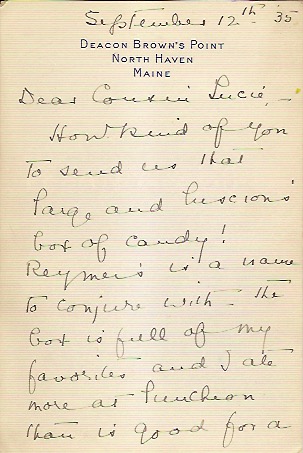
1935 Elizabeth C. Morrow note to Lucie Brown Ballantyne -Sep.12

Deacon Brown's Point, North Haven, Maine was the summer home of Dwight Morrow 1873-1931, former Ambassador to Mexico (1927-1930) and U.S. Senator from New Jersey (1930-31).  His father's youngest sister, Mary Virginia Morrow Brown 1857-1890, was the mother of Lucie Brown Ballantyne 1880-1957.  Thus, Dwight was first cousin to Lucie, and a first cousin twice removed from the Ballantyne-Dailey-Uible cousins.  

Dwight's wife, Elizabeth Reeve Cutter Morrow, 1873-1955, wrote the following note to Lucie in September 1935.  Transcription follows.


September 12 '35
[DEACON BROWN'S POINT
NORTH HAVEN
MAINE]

Dear Cousin Lucie, –

How kind of you to send us that large and luscious box of candy!

Raymer's is a name to conjure with : the box is full of my favorites and I ate more at luncheon than is good for a grandmotherly figure.

We all send you a warm thank-you for such a generous present !  This is a sweet-tooth family – just the kind to appreciate your gift.

I'm glad that your trip was a success.  You sent me such a kind note about our little visit.  The pleasant day we were all together is marked in the guest book with the group picture.  I will see you [sic] that you get one later.

Ever sincerely,
Elizabeth C. Morrow

Other posts about the Morrow family include:


Tuesday, July 14, 2015

1835 Freeman's Landing Union Chapel

The following clippings are arranged in slightly different order than they are transcribed, due to their irregular placement on several different pages of the newspaper.  Thomas Freeman (1793-?), one of the founders of the Chapel, is the 3rd Great Grandfather of the Ballantyne-Dailey-Uible cousins.

Thomas Freeman's son James L. Freeman (1809-1892) was the father of Virginia Irene Freeman Ballantyne (1840-1906) who was the mother of our grandfather, Nathaniel Wallace (N.W.) Ballantyne (1868-1949).

Further research would be needed to determine if or how other early members, such as the Browns and Morrows are related.  Partial transcription follows.
Picture of Zalia Church and attendants at 100th anniversary of the founding.
[Identity of "Jennie" is unknown.]


Some of the pastors and officials of the church and some early and present members are pictured.  John. C. Freeman is third from left in back row, Mrs. George Freeman is third from left in front row with Miss Mary Brown fourth from left.

100th Anniversary
Union Chapel Was Founded at Freeman's Landing in 1835.  
Sunday Devoted to Celebration of Founding
The Independent, New Cumberland, West Virginia
Thursday July 18, 1935

The historic M.P. [Methodist Protestant] church at Zalia, Hancock county known in the early days as "Union Chapel of Freeman's Landing" celebrated its one hundredth anniversary of its founding with appropriate services being held Sunday, July 14, 1935.

Services began in the morning and continued throughout the day with intermissions for dinner and supper.  The food was served by the ladies of the church and several hours were spent in a social way, renewing friendships and relating past history of the chapel and its members.

Rev. I.J. Howland is the regular pastor of the church, having been assigned to the charge by the Pittsburgh conference, along with his pastorship of the New Cumberland M.P. church.

The morning sermon was preached by Rev. Samuel Spencer, a former pastor of the Zalia church and Nessly chapel and in the afternoon, Rev. C.A. Daugherty of Empire who has been occupying the pulpit at Zalia delivered the sermon in the afternoon.

Both discourses were appropriate for the occasion and in the evening Rev. Howland delivered the address and his theme was "The Passing Years."  His sermon touched on the early founders of the chapel and the people that have continued in keeping the good work going on for a hundred years.  Rev. Spencer and Rev. Daugherty took part in all the services, while Rev. Howland presided during the celebration.

Mrs. Fred Dunleavy and Mrs. Ruth Jones sang duets at the afternoon and evening meetings and Mrs. Howland gave a reading.  The evening program opened with a song service with twelve choir members, a duet by Rev. Howland and Mr. A.S. Cooper, and a duet by Rev. and Mrs. Daugherty.

Rev. Howland called upon a number of the attendants of the celebration for reminiscences of the chapel and quite a number related interesting history.  

Only three near relatives of the founders of the church were present and they were John C. Freeman of Toronto [Toronto, Ohio is about 20 miles away], N.W. Ballantyne of New Cumberland, and Miss Mary Brown of Toronto.  Miss Mary Brown is the oldest surviving member of the church and her father, James Brown, was a cousin of the Rev. George Brown, the first pastor and one of the organizers of the chapel.  Thomas Freeman, grandfather of John C. Freeman and great-grand-father of N.W. and C.A. Ballantyne of this place was one of the founders of the church, and donated the land.  

John Freeman was a son of Samuel Freeman and the latter a son of Thos. Freeman.  Mr. Freeman gave a history of the church taken from the old family records.

Organized in 1835

The Union chapel, located near Freeman's Landing, now known as Zalia in Butler district this county [Hancock] was organized and services held in 1835.  This county was then a part of the old state of Virginia and the deed for the church property is recorded in Brooke county.  The founders of the chapel were Thomas Freeman and his wife, Thomas Anderson, (unmarried at that time_, James Black and wife, Robert White and wife and John Sutton and wife.  The first meetings were held in an old brick school house until 1857 when they erected the present church.  Rev. George Brown, who was a pastor of the Nessly chapel assisted in the organization.

The Union chapel was at one time one of the leading churches in the county, attended by the Freemans, Ballantynes, several Porter families, the Browns, the L.R. Smith and John W. Morrow families of Kings creek, the Wilson, Bradleys, Andersons, McConnell's, McAdoos, Hugh Irwin and sisters, Reuben Taylors family the families of Johnson Miller, Calvin Grimes, Wm. Jester, the Morans, the Lyons and many others.

George Porter gave the first argan [sic] to the church and Mary Porter Blackburn a daughter played the instrument for 12 years.  Misses Martha and Alice Porter, of Pittsburgh, daughters of the late George and Maria Moren Porter, sent a contribution to the church, but were unable to attend the celebration.  Their mother was a teacher in the Sunday school for many years.

 . . . . . S. B. Goucher spoke as to the early days when he attended Sunay school . . . in the time of the civil war.  He recalled that Freeman's Landing had quite a settlement of people and later yars there were ten brick yards from Kings creek to the Black Horse, New Cumberland.  Bricks were made like in the early days of Egypt, made during the summer when the sun was hot and dried by the sun rays.  In winter time the clay was dug from the hills.  THe brick were transported by Keelboats, there were no railroads in this section.

Thomas Freeman, one of the founders of the church made the first fire brick west of the Allegheny mountains.  [Family history indicates he began in the clay and brick business in 1833 at Freeman's Landing.]

N.W. Ballantyne, a great grand-son of Thomas Freeman was present and was called upon and stated that he had attended this church and Sunday School when a boy and that there was a big attendance, and annual picnics were held, and that this chapel was the leading church in this section of the county.  


* * * * * * * * * *

Union Chapel information from other sources:


The scanned clippings from The Independent  New Cumberland, West Virginia, Thursday July 18, 1935 is a write-up of the 100th Anniversary of a church, originally known as Union Chapel of Freeman's Landing" in an unincorporated community, now known as Zalia, in Hancock County, West Virginia.  According to Wikipedia [1] the community has also been known as Brickyard Bend.

The East Liverpool Historical Society reports that "The Union Chapel of the Methodist Protestant Church was built in 1835 at Freeman's Landing north of New Cumberland?  There were 877 _graves listed in 1995."[2]

THE UNION CHAPEL is described in History of the Pan-Handle in 1879: Is located near Freeman’s Landing, in Butler district.  The Methodist Protestant society of said place was organized in about 1835, by Rev. George Brown, with Thomas Freeman and wife, Thomas Anderson, James Black and wife, Robert White and wife, and John Sutton and wife. The first meetings were held in an old brick school house until 1857, when they erected the present church.  The ministers were the same as those found in the history of the Nessly Chapel.  Rev. John Gregory is the present pastor.  They have a membership of about sixty.

Sabbath School.—In connection with the church, they have had a Sabbath school for a number of years.  During the summer months they have an enrollment of one hundred scholars, T. F. Henderson is superintendent. [3]

Websites listed below were accessed in July 2015
[1] Zalia also known as Brickyard Bend: https://en.wikipedia.org/wiki/Zalia,_West_Virginia 
[2] East Liverpool Historical Society, Rest in Peace Part 4 website: http://www.eastliverpoolhistoricalsociety.org/restinpe4.htm
[3] History of The Pan-Handle; being historical collections of the Counties of Ohio, Brooke, Marshall and Hancock, West Virginia.  Compiled and written by J.H. Newton, G.G. Nichols and A.G. Sprankle. Wheeling, W. Va., published by J.A Caldwell, 1879.  https://www.google.com/url?sa=t&rct=j&q=&esrc=s&source=web&cd=2&ved=0CCQQFjABahUKEwjp8_KPndfGAhUHLIgKHen5ChM&url=http%3A%2F%2Fwww.genealogypitstop.com%2FNewton%2FPanhandleHistory.rtf&ei=1TijVam1MofYoATp86uYAQ&usg=AFQjCNGf_GytKGCwiMcWSfiiewWHW_bqMQ&sig2=EqUpf5e4g3OXMI1Utg_PLQ&bvm=bv.97653015,d.cGU&cad=rja

Sunday, December 30, 2012

Agnes Morrow Scandrett book

"LIGHTS ARE BRIGHT, SIR!" The tale of two grandmothers cruising the coast of West Africa in a cargo ship. Told in actual letters from Agnes Morrow Scandrett. Published by Howal Stationary & Printing Co., New York City, 1932.

Agnes Morrow Scandrett, 1869-1953, is a first cousin 2x removed of the Ballantyne-Dailey-Uible (BDU) cousins. She is the daughter of James Elmore Morrow, whose portrait unveiling was featured in the blog on Dec. 2. Agnes was a first cousin to Lucie Brown Ballantyne, and thus the 2x generations removed for the BDU cousins.

The Library of Congress has a microfilm copy of this fancy paperbound book but there are no other public library holdings listed.  Most copies are probably now in the private libraries of family members – like us.  Partial transcription follows.

1932 Title page of  "Lights are Bright, Sir!" The tale of two Grandmothers cruising the coast of West Africa in a cargo ship.  Told in actual letters from Agnes Morrow Scandrett.  Front cover design shown from reverse on left side.

First page of  "Lights are Bright, Sir!" X'd out parts possibly marked as parts not to share during a recitation.  The transciption below will also omit the X'd parts.
On Board WEST IRMO
December 13th [1931]
Dear Family,
Now we are enjoying life and sunny weather – but for ten days we had storms and gales and bounding billows.  This tub has surely pitched and rocked and creaked.  One night everything on the ship seemed to be loose!  Not a bit of land nor a steamer have we seen since we left New York, – nothing but rain and stormy water.  

We have only seven passengers – all white – and no one else is going as far as we are, – all the way to Angola and up the Congo.  If we take on some passengers of color father down they have a different quarter.

It is a great lark for us two grandmothers and we are looking forward to our promised adventures such as riding in a Mammy Chair – a kind of bucket.  And there is even a possibility of an airplane into the interior of the Congo!  Doesn't it sound thrilling?

At first glance our passengers looked to be rather a job lot, but as usual we found them interesting on acquaintance.  Two missionaries – not yet related; an Animal Man who goes every year to bring wild animals from Africa for zoos and circuses; a Cape Verde Island business man – Portuguese, with his little boy (a nice child, though suspiciously dark-skinned).

Pages 6-7  of  "Lights are Bright, Sir!"  Chosen for display because of the Dakar, Senegal connection.
December 14th [1931]
We have furnished everybody a lot of amusement with our appliances.  We use the vibrator every day and the Captain is giving us a room especially for it when the first passengers leave.  I suspect he wants to try it himself!  We are enjoying our wonderful boxes of food, thanks to you all, and for Mary's poetry, too (says one poet to another!)

All these things are a great aid to our popularity.  The Captain gave out a great guffaw when I told him I would bring a Frigidaire the next time!

Every morning we appear at breakfast with the coffee pot and the toaster (everyone likes our toast and coffee), and in the evening with the teapot or the tomato juice.  Did you ever notice that ships never have much use for tomatoes?  In the evenings we have parties with the cakes and candy after we play Bridge with the Captain and the Purser – sometimes the Animal Man.  We have tried Contract, but Allie is a very good player and the Captain has a "system of his own" and so we think he is a good Captain.  Not a bit of liquor has been visible since we sailed, but we do not seem to miss it. 

I really think this trip is much more fun than the de luxe cruises.  The Captain tells a few good stories, – one about the natives' mode of communication.  He said they had a few native passengers, or stevedores, a few days out of Freetown, and they passed close to another ship from which the natives could hail each other.  One thin long chap on the other boat called "Ehe! Ehe!"  The one on our boat called back "Ehe! Ehe!"  That was all.  The Captain said to his boy: "Well, what's the news?  Reply:  "He says Obadiah's wife ran away and married another man!"  And afterward the Captain verified the story and found it true!

I'll save the other stories for another time.  Take care of the cat and the dogs.  And get ready for the leopards!  I'll promise to bring no snakes!!

Merry Christmas and Happy New Year!  – Mother

Dakar, Senegal
December 16th [1931]
One of our freight ships going home is in port, so after all I ventured only two letters by air mail, as they told us these planes go over the Riff country and are frequently shot down by bandits.  Consequently it is the custom to duplicate all letters and trust to Providence only the hasty ones.  I admit I always have felt that way about air mail anyhow.  (Don't show this part to Charles and Anne [Morrow Lindbergh]).

This place was quite a surprise to us, with its up-to-date docks and quite extensive harbor, with many French cruisers anchored here.  Senegal is under French dominion and the headquarters of the French West African Army.

We enjoyed our stop here very much.  One novel sight was the mountains of uncovered peanuts on the docks, with paths and ramparts of filled bags of peanuts on which the natives walked to empty their loads.  A flock of birds perched on top would frequently and suddenly rise when disturbed by a boat whistle or other sudden noise.  We discharged a large consignment of gasoline (essence!), oil, and tobacco at this port.

All hands went up to town to get some money and helmets.  The Captain took us around and went with us for a drive to Cape Verde, the western outpost of Africa.  Just two very disreputable looking taxis were available.  I chose the open one, and my choice was surely fatal (though no one can every prove to me that the other one would have gone any better!)  We really had a walk for our money, as our car wheezed out and died after we had walked up numerous hills, Captain and chauffeur pushing, and we finally had to be brought home by a stranger, – a kind French lady driving with her baby and her dog.  My French went away up on the top shelf of my mind and she looked quite started and amused when I thanked her.  My memory seems to tell me that I said "Bon Dieu" instead of "Merci."

After this episode, or adventure, we sat at a sidewalk cafe and absorbed some atmosphere to the tune of a brassy band.  It was all very gay and Frenchy and the air was mild.  Beautiful Senegalese maidens were flitting about the table selling peanuts instead of the usual cigarettes.  Many French officers were sitting about, as this is the headquarters of their African army.

We had a delicious dinner in the Cafe de Palais.  The cafe is quite a building with a lofty domed ceiling painted sea green, with voluptuous mermaids swimming about.  One dish was that nice lobster crayfish we had so often in Panama, and we had some real Sauterne.  After dinner we went to a cabaret open to the sky; some of the pillars were the trunks of trees whose tops were green.  It was quite attractive and some pretty white girls (probably slim young devils!) were dancing and singing naughty French songs, dressed at least as modestly as the ones I have seen in New York.  Our purser, who had dinner with us, brought two boys from the other ship, so we were well escorted.  These boys sailed at one o'clock that night, and most of our letters went by them to Boston.
 
Last page (34) of  "Lights are Bright, Sir!"  Top part of page and part of previous page transcribed below.
Posted by Picasa
On  the High Sea
February 25th  [1932]
Dear Rebekah et al:  [her daughter, Rebekah Scandrett Greathouse 1893-1957]

Here we are on our last lap, sailing with a romantic and aromatic cargo.  We are laden with cocoa beans, palm oil, huge mahogany logs, and ginger.  The ginger is right in the hatch by our door, so we are enjoying the scent mixed with the sea breezes.  Quite an improvement on the gasoline and oil we took down, but that was enclosed in drums and did not annoy us over much.

. . . . In Freetown we lost our noisy, useful and amusing Kroo men.  They lined up for the health officers in all kinds of wearing apparel from undershirts and shorts, overalls, to derby hats and shirttails out!  Then they worked like Trojans loading on ginger and at midnight departed in a weird line of boats attached to the lighter, and vanished into the solemn darkness.

Our Animal Man, whom we left in Freetown, came out to see us.  Already he has 400 animals, including snakes, an ant eater, and over a hundred monkeys or baboons and chimpanzees.  (I must say that I am rather glad he and his animals are not going back with us!)  He was very glad to see us....  I decided not to bring home the baby leopards after hearing from you all.

. . . . Farewell to Africa!  – Mother

Sunday, December 02, 2012

James E. Morrow 1837-1904

James Elmore Morrow, born March 28, 1837, was the oldest of seven children of Alexander and Sarah Jane Wilson Morrow.  His youngest sibling, Mary Virginia Morrow Brown, 1857-1890, is the mother of Lucie Brown Ballantyne, grandmother of Jean Ballantyne Uible and the great-grandmother of the Ballantyne-Dailey-Uible cousins, making James a great-grand-uncle.  James was the grandfather of Anne Morrow Lindbergh.  James passed away December 12, 1904.
Portrait of James E. Morrow 1902.  Signed Cordially Yours, Jas. E. Morrow
Photo by D. Rosser  [According to History of Pittsburgh, David Rosser, born 1868 was one of the leading names in photography in Pittsburgh.  It is unknown whether the painted portrait mentioned in the article below was done from this photo or at a separate time.

[Clipping undated from unknown newspaper, probably from 1941 based on info on back side of clipping about Battle of Crete in 1941.]
Portrait of Jas. E. Morrow Presented
Unveiled by a Great Grand-Daughter

An oil painted portrait of Dr. James E. Morrow who was born in Fairview, now Pughtown, Hancock county, W. Va., was presented to the Allegheny high school, Pittsburgh by the graduation class of 1899. The ceremonies were held in the Allegheny high school Tuesday evening, June. 10.

The portrait was unveiled by a great-grand-daughter of the late James E. Morrow, Nancy, 10, daughter of Mr. and Mrs. Richard B. Scandrett [the clipping repeatedly misspells this name as Scrandrett] of New York.  Two daughters, only surviving children of Dr. Morrow, Mrs. Agnes Morrow Scandrett [1869-1953]  and Mrs. Hilda Morrow McElvain [1874-1954] were present at the presentation.  They both reside in Englewood, N.J.  Other members of the Morrow family connection attending were Mr. and Mrs. John Miskelly, Mr. and Mrs. N.W. Ballantyne, Mr. and Mrs. R.M. Brown, New Cumberland, and Mrs. Alice Morrow Leacock of Pittsburgh.  Mrs. Miskelly, Mrs. Ballantyne and Mrs. Leacock were nieces of Dr. Morrow and R.M. Brown is a nephew.

Dr. James E. Morrow was the eldest of seven children and was born in Fairview on a farm and attended the common schools of that day; farming did not appeal to him and at the age of 15 entered Jefferson college, now Washington and Jefferson and graduated in 1856, the youngest member of a class of 57.  His intentions were to study law, but did not have sufficient money to take the law course.  He taught first at the little academy in Fairview and in 1871 he was elected president of Marshall college in Huntington W.VA., [where Lucie taught elocution in the early 1900s.]  and also served as president of West Liberty.  He married Clara Johnson of Wellsburg and eight children were born.  Three died in infancy.  Agnes, Jay, Alice, Dwight [father of Anne Morrow Lindbergh] and Hilda survived.

In 1879 Dr. Morrow went to Pittsburgh and began his work in the Allegheny schools and it was while at Allegheny that Washington and Jefferson honored him with the degree of Doctor of Philosophy.

All the Morrow children were educated, Jay J. Morrow was a graduate of West Point and served as engineer commissioner of the District of Columbia, Governor of Zamboagna in the Philippines  Governor of the Panama Canal [I saw his picture there!], Chief Engineer of the First Army in France and chairman of the Tacna-Arica Boundry Commission.  [James' children would be 1st cousins 2x removed.]

Dwight Morrow graduated in high school at 14, graduated from Amherst and Columbia Law School of New York, became a leading lawyer in New York city, a partner of the J.P. Morgan Co., Ambassador to Mexico, United States Senator.  His daughter Miss Anne Morrow married Col. Charles Lindbergh.  The daughters of Dr. Morrow married, with the exception of Alice who followed teaching as her career, now only two of the immediate family survive.  [James' grand-children would be 2nd cousins 1x removed.  His great-grandchildren would be 3rd cousins.]

* * * * *
The following story was obtained from ancestry.com:


James E. Morrow, Principal, Slippery Rock State Normal School, 1889 - 1890
James E. Morrow was appointed principal and professor of psychology and history of education in early 1889.  Assisted by the school’s six faculty members, Morrow developed the first program of studies.  The initial philosophy of the school was to make the Normal School Student, as far as possible, an educator. 
On March 9, 1889 Morrow sent an announcement of the new Normal School to the general public identifying its special advantages as follows: healthfulness; convenience; noted honesty, hospitality and religious character of community; new commodious buildings, thoroughly warmed and ventilated; and named the four protestant churches of the community.  In addition, he identified the three expenses students were expected to pay each term: tuition - $14; board, room rent, fuel and light - $32s; and transportation of student and baggage from the Kiester’s rail station - $.25.
The first term began March 26, 1889 with 168 students enrolling, 94 women and 74 men. More than two thirds of the entering class came from Butler County with neighboring counties accounting for essentially the remainder.  Two students from nearby Ohio also enrolled in the first term.
            Born in West Virginia in 1837, Morrow received the first of three academic degrees from Jefferson College (now Washington and Jefferson College) in 1856.  Practicing law when the Civil War broke out, Morrow enlisted as a Private and advanced to the rank of Captain in 1863, in Company F of the first Virginia volunteer infantry.  Following the war, he returned to education rather than law.  He married Clara J. Johnson of Cumberland, Maryland, in 1867, and raised five boys and three girls: Fred, Earle, Ralph, Jay, Dwight, and Agnes, Alice and Hilda.  One son, Dwight, gained fame as a lawyer, legislator and American Ambassador, while Dwight’s daughter, Anne married trans-Atlantic aviator, Charles Lindbergh.  It was Anne and Charles’ 20 months old son, Charles Jr. who was kidnapped in 1932 resulting in a nationally publicized investigation.
In 1878, James Morrow began teaching mathematics at the Old Central High School in Pittsburgh.  Two years later, he was appointed principal of what is now the Conroy School in Pittsburgh.  While completing his Ph.D. at Jefferson College, he was appointed principal and professor of psychology and history of education at the newly founded Slippery Rock State Normal School.
After a brief 18 months, James E. Morrow resigned as principal.  There are no written records of the Normal School during this time period due to a dramatic flood of Old Main in the early part of the 20th century.  An alumnus from the early teens whose family was associated with the Normal School at the time of Dr. Morrow’s resignation reported that Dr. and Mrs. Morrow held a wedding reception on campus for one of their children and served alcohol.  This was strictly forbidden as no alcohol was permitted on campus or within the community.  The alumnus reported that the serving of alcohol resulted with the immediate termination of employment for the Normal School’s first principal

Saturday, April 09, 2011

The Painted Pig by Elizabeth Morrow

Lucie Brown Ballantyne (1880-1957), and her brother, Robert Morrow Brown's (1877-1946) mother, Mary Virginia Morrow Brown (c1857-1890) was a sister to James Morrow.

James Morrow's son Dwight (1873-1931) was a businessman, politician and diplomat.  He was a classmate of Calvin Coolidge at Amherst College in the early 1890s, married his college sweetheart Elizabeth Reeve Cutter in 1903, and became a partner in J.P. Morgan and Co., in 1913.  They were parents of four children, including Anne Morrow Lindbergh.

President Coolidge appointed Dwight Morrow Ambassador to Mexico where he served from 1927-1930.

Elizabeth Morrow (1873-1955) of Cleveland, was the daughter of Charles Long Cutter and Annie E. Spencer and was a poet as well as the author of two children's books, one of which, The Painted Pig she signed and inscribed for Jean Ballantyne on October 6, 1930, the year it was published.


Posted by Picasa

Summary: When the toymaker forgets to make him a piggy bank, a young Mexican boy finds some clay and tries to make one of his own. Includes historical notes on Mexican folk art and the author's experiences in Mexico as the wife of the United States ambassador in the 1920s.

From information about the book: This delightful picture book, first published in 1930, was written for children, but as a beautiful evocation of an era of awakening American interest in Mexican art and culture it will appeal to adults as well. The author, Elizabeth Morrow, first went to Mexico in 1927, when her husband, Dwight Morrow, was appointed American ambassador. The story is about a remarkable painted pig with a savings bank manner and a very stylish rosebud tail. The pig belongs to Pita, and is coveted by her younger brother, Pedro. Pancho, “The Toymaker” in the market, promises to make another one, but between the promise and the delivery is a wonderful story-telling journey.
The Painted Pig was inspired by the extraordinary collection of Mexican toys created by the author’s friend René d’Harnoncourt, who illustrated the book.

A facsimile of the first edition, published by the University of New Mexico Press in 2001, includes an introduction by a folklorist who knew Mrs. Morrow when he was a boy and an afterword by two of her granddaughters.

“Color, rhythm and a true understanding of children . . . set this book apart. It is in no way derivative, nor can it be compared with any other book.”—New York Herald Tribune

*****
The Painted Pig is one of several books in the Uible/Ballantyne vintage book collection which also includes some of Robert Morrow Brown's books from the late 1890s.

Items from Uible photo album